Showing posts with label UNESCO. Show all posts

Saturday, May 8, 2010

Guitar Hawaii, something to feel about Hoi An Ancient Town

Along the coastal street from Danang City to Hoi An Ancient Town, a UNESCO World Heritage Center, luxury resorts stand side by side while others are under construction. Suddenly, a big sign stands on the right showing a foreigner playing guitar with a Vietnamese band at café Guitar Hawaii.

The café is located near An Hoi Bridge, which is a few steps from the Japanese Bridge –the symbol of the ancient town. Guitar Hawaii opens every night bringing to customers a warm and comforting atmosphere.


Nguyen Huu Tam, 34, the Guitar Hawaii owner, studied music at the Hue University of Arts in the ancient capital of Hue after high school in his home town of Hoi An. In 1997, he became a well-known guitarist among higher education students across the country since his student band Co La (Strange Grass) won the consolidation prize in the 1997 National Unplugged Music Contest. Co La was also voted as the most impressive band in that student competition. more>>

Friday, March 26, 2010

Quan ho Bac Ninh singing
Quan ho Bac Ninh singing (Bac Ninh folk love duets) and Ca tru (ceremonial songs) have recently been recognized as “an intangible world heritage” by UNESCO, said an official of the Ministry of Culture, Sport and Tourism.

 Accordingly, Ca tru has been listed as a “cultural heritage in need of urgent safeguarding.” 

Ca tru is highly appreciated for its art value in the Vietnamese culture. Ca tru, which dates back to the 15th century, has also been listed among 12 “intangible global cultural heritage traditions in danger of disappearing.”  read more>>

Wednesday, March 10, 2010

Vietnam's stelae declared Unesco World Heritage Site


 The doctoral steles at the Temple of Literature in Hanoi are recognized by UNESCO as world documentary heritage
 
The UN Educational, Scientific and Cultural Organisation (Unesco) has declared the 82 stelae of the Temple of Literature in Vietnam as a World Heritage Site, Prensa Latina reported.
The Temple of Literature, located in a park in central Hanoi, was founded by emperor Ly Thanh Tong in 1070. It is dedicated to Confucius.
Vietnam's first university was established in the complex in 1076 to train the administrative and defense staff.
It has 82 stelae mounted on top of giant tortoises that line on the side of the temple. They date from 1484 and record names, birthplaces and achievements of the men who received doctorates here.
Names of 2,313 students graduated from the institution between 1484 and 1780, during the Late Le, Mac, Trinh and Nguyen dynasties, were sculpted in the stones.
Although the complex has undergone many changes over the centuries, the architecture of the site belong to the Ly (1010-1225) and Tran (1225-1400) dynasties, a recent study has showed.
The Unesco recognition was approved recently in Macau, the report said Wednesday.

Saturday, November 22, 2008

Hue and Gastronomy

Prior to our first trip to Viet Nam, I spent about a month and a half doing research in order to have some kind of idea what not to miss where. Of course, Hue is where you can find the glory of past Imperial Viet Nam, to the extent that it is still on UNESCO's list of world heritage sites. But it is also the center of where a lot of the destruction took place during the American War. Additionally, it is known for its amazing cuisine, and has the best University in the entire country. 


Luckily for us we stayed at a hotel that was abutting the Center for Gastronomic Service . It does not look terribly fancy or elegant, but don't let appearances get you down. The food is out of this world. This was the place where we had breakfast the day after we arrived and did most of the sightseeing. It was extremely crowded, and the restaurant is "al fresco" for the most part. While you wait for your food, you will be either charmed or annoyed by vendors, depending on your mood. One other thing that can ruin your meal, if you allow it, is the smell of smoke. Viet Namese are smokers, like most other Asians. And even when you are outdoors, you'll still get several whiffs of it, as the smokers outnumber the non-smokers. 


This is the view from the eating area where we sat, 
which looks quite charming with a lovely fountain in the center, and tropical plants all around.


So if you don't mind sitting on rickety aluminum table and chairs, and spotting a running chicken pecking at the ground, have a seat and enjoy the meal, because you will. This is a good time to explain the coffee filter situation, since I have a photo of it, and as I mentioned in an earlier post, once you have this coffee, it will be difficult to negotiate other ones. It can be served to you hot or cold, and in order to have the hot version, you should ask for 'cà phê sữa nóng', literally hot milk coffee or café filtré. This will be made with sweet condensed milk. For the iced version, ask for cà phê sữa đá, and it is basically the same recipe, with added iced cubes and that you'll stir vigorously with a long teaspoon and enjoy.

If you look closely, you see the glass which has the filter mechanism on top of it also has a thick white lining at the bottom. That is the condensed milk which has not yet been mixed. When enough coffee has made it into your cup, just set aside the filter until you are ready for more. The glass in the forefront shows the coffee has been mixed and some of it already consumed. On the other side is the same operation going on with another glass containing ice cubes. I think you have now been initiated. I remember when they first brought us these utensils to our breakfast table in Sai Gon, we looked at each other like idiots, because we had no clue how these things worked. 

A banana crêpe was beckoning me from the menu and I didn't resist. I had no idea though that what I would later be served and eating was art work. Chuck ordered eggs (at the time of our travel, there was much to do about nothing regarding bird flu, and not eating fowl or eggs). Baguettes are always served at breakfast, and they are crisp and tasty, and have slightly more dough than I am accustomed to. When our food came, my jaw dropped at the sight of the crêpe as I was expecting a pancake stuffed with bananas. I will shamelessly admit that I ate the whole thing. 

With the sunny side eggs came the bread, a few slices of cucumbers and tomato, and the portion was quite generous. This restaurant is a keeper. 


The evening before, after we returned from an exhausting tour of the Forbidden Imperial City, after we crossed the Truong Tien Bridge back to the other side, we got out because we spotted a very large outdoor eatery that served iced cream. It sounded like a wonderful idea, and refreshing, and don't expect vanilla, chocolate and strawberry. These folks learned the art of ice cream from the French, and will have you lick your chops no matter what flavor you choose. Learn that "Kem" is ice cream, and short for "crème" which is the French word for cream. If you want to find it, it is on Le Loi Avenue, right across the street from the Viet Nam Airline ticket office. You have a wonderful view of the Perfume River , and it was almost sunset, which made for a very soothing and romantic mood. 


The Perfume River gets its name from the fragrant flowers that grow alongside its banks.

The menu is in Viet namese, but there do have English translations, and we were happy to get one of those from our waiter. I'm a red bean fan, but I saw "green bean" and was intrigued, and ordered it. Chuck, on the other hand, went American, and selected the banana split with one scoop each of 3 flavors (the ones cited above, of course), which was served with a fluted cookie and walnuts. The first teaspoon of green bean was spectacular, and the ones that followed, no less spectacular. The cookie was light as air. And since my cup was small, I started tasting some of the ice cream in the banana split boat. They use real cream!! Also, remember, you must slow yourself down as much as possible because service takes forever. And this, - with the venue not crowded at all. I think we saw one other family with children in total. 


There was a very large building which looked like a theater of some sort, and after we left "Kem", we started walking around. Again. We went into the building which was completely empty, and there was no one around. Parked alongside the river bank were these adorable duck boats, which I assumed people rented out to glide around on the river. There are also performances which take place on the river, but we unfortunately did not have the time to catch one. 


As the sun was setting, we realized that once back in the hotel, we would not be able to move. So our walk to us to an outdoor restaurant, with tables at seaside. You could see the trees around the tables had been decorated with hundreds of mini-lights that would go on as soon as the sun disappeared. It was very quiet, but as I looked up I saw speakers, and music began to emanate. This might sound bizarre, but the man singing sounded exactly like Engelbert Humperdinck in Viet namese. Since our server did not speak English, there was no way for me to know. But it was lovely and memorable. And we were given menus and started peering at the offerings; here's a sample:
· #61. My (pronounced me) y Sot Bo Bam : Sauteed spaghetti with beef
· #62. My y Sot Hai San : Sauteed spaghetti with seafood
· #63. Vu De Neong : Grilled teats of goat (this one triggered a half hour conversation)
· #64. Tho Hon Banh My : Stewed rabbit with break ( I think they meant bread here)
· #65. Tho Nuong : Grilled rabbit
· # 66. Ca Com Chien Bo : Deep-fried small fish with butter
We settled on a vegetarian dish that was spiced to perfection and quite fragrant. It went down without a hitch. It was a noodle dish with curried vegetables, but you really could not distinguish any heavy curry flavor. It was so subtle, and mixed probably with other aromatic spices. 


And of course, it would not have been as memorable an evening, if it weren't for two young boys who were trying to get some money for polishing our shoes. I was saved, since my shoes were suede boots that could not be touched. So they naturally turned to Chuck, and it became comedic as we realized the tins of shoe polish they had brought with then were empty. Nevertheless the younger of the two boys was earnestly scrubbing away. The other boy had his hand on my camera at one point, and I gave him a look that must have encouraged him to let go of it. All the pictures of the day that I had taken were in that camera, and at that point, I would have killed anyone who would take the camera. 
There is a fabulous dialog going on between the man and the boy in the photo. It turned out that the shoe polish had at some point in its lifetime contained black, and Chuck's shoes were brown. So the man is trying to tell the boy not to shine his shoes because he's got the wrong color. You can see the pained look on the child's face, because he is looking to make some dong this evening. 


At some point, the conversation will have stopped because the grown up realizes that the child is so persistent, he might as well let him have his way. We did manage to find some coins to reward all that hard work. At least they did leave us when the food was served. 


A barge gliding on the Perfume River at Sunset

Saturday, November 15, 2008

Hue: How Emperors Lived

The past splendor of this imperial city cannot be justified in the less than 48 hours we allowed ourselves for this visit. The entire schedule was crazy, because there was so much we wanted to see, and so little time we had. Actually, it wasn't a full 2 days, more like a day and a half, with some sleep in between. We arrived by train from Ha Noi, and as usual, expected to be accosted by every cyclo and cab driver waiting for customers at the station. Luckily, our hotel was a stone's throw from the station, but we were carrying way too much. 


As with everything in my travels, I'm not going to take the usual route with you to Hue. That would be to take you to the forbidden purple city, and we'll leave that perhaps for last, since it's "dessert" and should be savored as such. I will take you to an emperor's vacation home, within the confines of Hue, but on the other side of the Perfume River.  Bear in mind that Hue is a UNESCO world heritage site, but it is in desperate need of repair, and some structures have suffered too much damage (during the Viet Nam War) to ever be restored.


On Le Loi Avenue, which is the main drag from the train station, it is rather quiet compared to the frenzy one encounters in either Ha Noi or Sai Gon. You can actually walk if you can stand the heat, by seeking refuge on the shady side. The avenue is tree lined, and as you approach the Truong Tien Bridge to the other side, cyclo drivers will be more than happy to transport you. Once you have crossed the river, (it's a really steep upgrade at first, and those poor drivers really need to hustle), do not get off until the driver has taken you to the gate of the Imperial City. Otherwise, you will end up like we did, - on the outskirts and live bait for other drivers that will literally hound you until you give in to them. 

This particular pair of drivers wanted to show us something out of the ordinary, so far as I was able to understand. It's usually more comfortable for each person to have his/her own cyclo, though we did double up on the way here, and it was murder for the poor driver. So one was driving ahead of the other, and since I had the camera, I was doing all the shooting while Chuck was falling fast asleep in his carriage. And so, we began rolling away from the Citadel to this mysterious destination. 


We passed some very poor areas, with street signs that were lopsided, and ubiquitious laundry lines, and children in their school clothing were either walking or on their bicycles. As we turned another corner, I made the driver stop so I could take a snapshot of what appeared to be the gate to a very elegant residence. There was some construction, apparently unexpected, so we made a detour. As I looked up, I saw rooftops with extremely ornate decorations, very typically Chinese as is the influence here. We will definitely see this influence repeated in the Imperial Citadel, which was modeled after the one in China. 

We finally stopped in front of a breathtaking gate and if a picture is worth a thousand words, then let me save mine, and have you take a look. 


the gate to Heritage House
Needless to say, anything we felt toward our pushy drivers disappeared the very instant we set eyes on this place. I learned that many of these abandoned imperial vacation homes have been turned into "heritage houses", and there are people tending to their upkeep. We were not escorted inside, but we were free to roam and look. I studied the columns of the gate, all the while admiring the ornate dragon relief decorations, all done in ceramic. There are areas that were covered in crabgrass, but they were charming ne
vertheless, as the sound of running streams permeated the air. As I carefully walked on the grass, I spotted a terra cotta container with a mostly spent candle inside. I assumed that at night, they set a romantic mood to this place with strategically placed candle holders like this one.  

I had wanted to see imperial bedrooms in a palatial setting, but this was not to be. Everything to be seen and admired was more or less out in the open, or in recessed covered areas. As you walk to the right from the gate area, you come upon a sitting area; the table and benches are faded, but one can imagine a royal setting. The carved doors are exquisite, and appear newer, or perhaps they had been restored. 

As you can see from the photo, there is a time warp between the wooden doors and the seating area. I did spot one young woman who may have worked there, and she was tending to the seating areas, as if expecting guests.  All the smaller tables in more intimate settings were covered with lace cloths, and I spotted paper menus on table tops. The furnishings in general were made to resemble Chinese cherrywood items. 


A lovely table setting in very serene surroundings


All that is missing are the guests

The architecture of Hue City is a composite of many influences. It was said that one its strongest influences came from Dong Son culture, accompanied by the influx of northern emigrants before the 2nd century and Sa Huynh culture after 13th century. These influences have resulted in the birth of Viet-Champa culture, which during its evolution, did not excluded influences from various civilizations (of southeast Asia, China, India, western countries, etc.). By the way, Champa culture has left some wonderful traces in Nah Trang, which we will be talking about later in the blog. 

Other items to look at and admire were the mother of pearl incrusted wood chests, as well as porcelain vases decorated with indigo blue motifs. The photo shows the high chest, and ceramics, and the pillar in the foreground does not betray the fact that there are only two walls to this "chamber". I got close enough to the statue to scrutinize the mother of pearl adornments which seemed very authentic. The statue must have been of a warrior. 

You might be tempted to purchase vases or ceramics, but you'll be able to make the killing at Bat Trang Village, so save your dong for that trip. However, you'll be glad you came here, which was the "playground" of the Nguyen Dynasty in all its splendor. By the way, Nguyen is the name equivalent of John or James in Viet Nam. Everyone is either a Nguyen, or knows a Nguyen. 


Thursday, March 20, 2008

Heaven on Earth

As we age, our criteria for a "heavenly" experience is more demanding. What may have transported us to seventh heaven a decade ago may leave us completely blasé now. In 1999, when I landed in Bali, I thought I may have accidentally found heaven. That notion went straight to the devil when I woke up one morning and found myself in Ha Long Bay.

We had heard of people who had gone there, and cruised, some on barges, others on frigates, and none on the
Emeraude. In fact, we probably were the first Americans to board this replica of the vessels that used to ply the waters of Hai Phong Harbor, in the early twentieth century, transporting the French Who's Who during their occupation of Viet Nam.

The Emeraude

The work that went into replicating that boat at the time cost US$2 million. More details about the vessel itself can be found in my journal called "Why the Emeraude". However, Ha Long Bay would still be heaven without it. As a matter of fact, after two separate cruises on the Emeraude, I now crave to experience it on one of the less luxurious, more authentics frigates that depart daily from Hai Phong Harbor.

This is more authentic and more Vietnamese

The fact that there really is no destination here is a joy. One never really tires at looking at the marvelous limestone monoliths which come in different shapes, sizes, and some even hold within their walls breathtaking grottos. We saw them in hazy weather, and in sunny weather and I found that the mystery and romance of Ha Long Bay is enhanced by the grayness of fog. Of course, a photographer's dream is probably Ha Long on a clear day, but there is a certain mystic quality to this world heritage sight when light is dim.

And they will stand here long after we are gone

As you approach the city, before you get a glimpse of the water, you can begin seeing these weird rocky formations framing the farmland. Oh yes, there are rice fields till the end of the world here. At first, they are not terribly impressive, but get progressively higher, wider, and shaped like some animals. In fact, the Viet Namese have dubbed a few of them (there are over 1900 of these in the Bay) according to their likenesses. Once aboard a vessel, and as the shore gets more distant, the quiet is almost eerie. The water is teal blue at times, at others it can turn transparent.


at times like a mirror

Because there are people who make the Bay their home, there will be areas that reflect what I call the "human footprint". The water is not as clean, but the houseboats are very colorful, and some are downright luxurious by fishermen's standards.
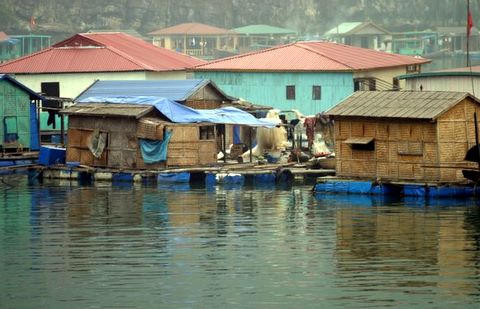
this is home for some

Naturally, when the Bay inhabitants spot the Emeraude, they all come in their canoes, and basket boats, some filled to the brim with all sorts of foods, drinks, souvenir items, seashells and some actually come to beg for money. Not the adults, but the children are made to do the bidding. We were told that the people who live in Ha Long Bay  are not poor. So I gave bananas, and whatever else I could find which I had brought from New York.
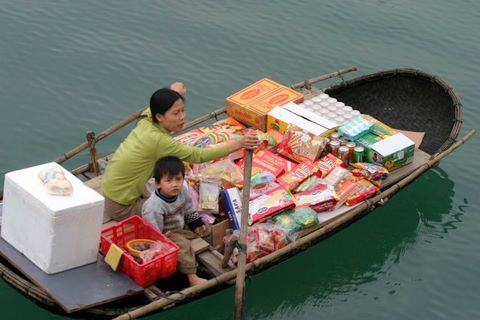
Chuck used to call this "Costco on Wheels"

There also reigns a surreal sensation of being surrounded by gigantic rocks jutting out of the sea that remind you of the smallness of humankind.

majestic and impenetrable

No matter how many people are on the ship, you feel singularly alone and in synergy with nature. The mundane and the pedestrian worries of the neurotic world have no place in Ha Long Bay. It's almost as if the limestones are laughing at you or showing off their staying power. You can wait for your breath to halt watching the sun set, or better yet, take a nap, have someone come to your cabin and give you a massage (which will force the nap) and wait for darkness.

the stillness is suffused in the orange light on sunset

Darkness in Ha Long Bay is total; it's intense and permeating. The only lights to be had are those on the curving deck; beyond that, the blackness of India ink could compete with the atmosphere. It's as if someone came and erased it all; the water, the rocks, the boats, the people, the sky and the clouds. Again, faced with the formidable, potent, relentless nature. Shall we have dinner now?

these chairs were right outside our cabin