Showing posts with label crafts. Show all posts

Tuesday, June 1, 2010

Hanoi Craft Week 2010 scheduled in August

VietNamNet Bridge - With the theme "Thousand Years Quintessence," the second annual Hanoi Craft Week will be held from August 4-9 at the Hanoi Friendship Cultural Palace to celebrate Hanoi's anniversary and the national tourism year in Hanoi.


With thousands of years of history, Hanoi is known as a land that epitomizes Vietnam. With the famous name "Land of One Hundred Jobs", Hanoi produces about 80 percent of the fine arts and handicrafts in the country. In recent years, traditional craft villages such as Van Phuc silk, Bat Trang pottery, Phu Vinh rattan and bamboo, Chuyen My mother-of-pearl and Ha Thai lacquer are more widely known both inside and outside Vietnam not only for their cultural achievements, but also for their social and economic values.

The upcoming Hanoi Craft Week 2010, held by the Hanoi Department of Trade and Industry and Abix JSC, will introduce the heart of Hanoi's craft villages. continued>>

Saturday, May 22, 2010

60 craft villages show off skills at Da Nang festival

VietNamNet Bridge – The Festival for Vietnamese Craft Villages 2010 opened at 29/3 Park in the central city of Da Nang on May 19, introducing unique products of 60 craft villages throughout the country.


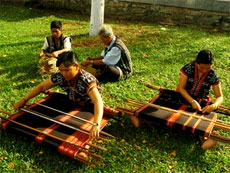
Apart from displaying their products in over 100 stalls, craftsmen will also perform their skills in making brocade, pottery, woodblock, and casting bronze drums.

The festival, the second so far, is a chance to honor traditional craft villages, which have existed for centuries.

Some products exhibited at the festival:

A wood painting from the Central Highlands province of Dak Lak.

Paper-made flowers from the central city of Hue.

Pottery items made by Cham artisans from Ninh Thuan.

A painting made by cajuput barks from Kien Giang province

Terra-cotta statues from the central province of Quang Nam.

Sedge-mats from Da Nang.

Bamboo-made products from the central province of Quang Nam.

Source: Dan Tri

Saturday, May 15, 2010

Silver artisans strive for success

LookAtVietnam -  Skilled artisans in Dong Xam, a silver-carving village, are struggling to solve thorny environmental protection issues and find new markets.


The ancient temple in Dong Xam (Kien Xuong District, Thai Binh Province) is dedicated to the founder of the silver-carving job.

LookAtVietnam -  Skilled artisans in Dong Xam, a silver-carving village, are struggling to solve thorny environmental protection issues and find new markets. 

Although he has reached the ripe old age of 80, Ta Duc Nhu still has no intention of saying good-bye to his hammer.
Nhu is a silver artisan in Dong Xam Village, Hong Thai Commune, in the northern province of Thai Binh's Kien Xuong District.  continued>>

Friday, May 7, 2010

Vietnam Gift Festival to take place in Vung Tau

Vietnam's first-ever Gift Festival will be held from November 17-21 in the southern province of Ba Ria - Vung Tau, Deputy Chairman of the provincial People's Committee Ho Van Nien announced on April 14.
The event will feature over 300 stalls, offering products of both domestic and foreign makers, seminars on the theme of gift-giving and a gift exhibition. 100 unique gifts from 100 craft villages nationwide will be auctioned on the occasion while 50 famous craftmen will showcase their gift collections.
(Source: VNA)
Related Posts

Saturday, May 1, 2010

Vietnamese Lacquer Painting (Son Mai)

Thanks to Hanoi Scratchpad for this report
Fifteen years ago, artist Ando Saeko came to Vietnam from her native Japan, and fell in love with Vietnamese natural lacquer painting (sơn mài). She was accepted as a student by Trinh Tuan, a master of the art form, and has been here ever since. Last Sunday morning at Hanoi's Uzu Gallery, Saeko explained the origins of natural lacquer and how lacquer painting evolved in Vietnam.

The term "lacquer painting" may be confusing; most of us probably think of lacquer as an additive to paint, or as a synonym for "varnish." I doubt many of us know that lacquer is a natural product made from the sap of an Asian sumac (the Vietnamese species is Rhus Succedanea). The sap is obtained in much the same way as rubber: an incision is made in the bark of the tree, and the resin is collected. The liquid separates as it sits; solids sink to the bottom and the pure resin at the top is skimmed off, mixed with pine sap, and stirred continuously for three days to give it an even texture. The resulting glossy material – processed natural lacquer – is used by artists.
The history of lacquer painting in Vietnam demonstrates this country's ability to take foreign influences, and create from them traditions that are wholly Vietnamese. Archaeologists have found lacquered objects dating back to the 4th century B.C., but lacquer was used mainly as an adhesive until the 14th century when, using techniques that are believed to have originated in China, it bloomed as a decorative medium. Lacquer began appearing as a glossy varnish on pagodas, wooden panels, palanquins, and other valuable objects, especially those of religious value.

It was the French who helped transform lacquer from a decorative craft into a modern pictorial art form. In 1925, teachers and students at the French École Supérieure des Beaux Arts de l’Indochine (Indochinese College of Fine Arts) began stretching the possibilities of the medium, taking traditional techniques and infusing them with contemporary artistic conceptions. The modern tradition of Vietnamese lacquer painting dates from this time.
Lacquer painting is a laborious process; it may take months or even years to complete a work. The term "painting" is, frankly, something of a misnomer; the medium is as sculptural as it is painterly. The technique of building a painting through layers, and of manually manipulating the surface, is as much a part of the process as the use of natural resin.

The foundation for a lacquer painting is a plywood board that has been covered by up to ten layers of lacquer. The artist may cut into this foundation to inlay crushed egg shells, gold leaf and other materials, or inlay materials directly onto the adhesive surface. Powdered pigments are lain directly onto the wet lacquer; color is built up in layers. Between layers, the artist continually scrapes, sands, polishes, and buffs the surface, to ensure an even finish. Since lacquer does not technically "dry" but rather hardens through the activation of an enzyme, the artist must be aware of ambient temperature and humidity; in less than optimal conditions one may have to wait days before applying new layers.
The result of all this layering, however, is that natural lacquer has translucent, muitidimensional qualities that could almost be described as holographic. Light plays on and under the surface of the painting. In much the same way that light fractures in water, the eyes perceive light and movement at multiple depths. One wonders what Monet, with his waterlillies, may have made of this stuff; it seems perfect for capturing the motile play of light and color that was so much a part of his oeuvre.
To some degree, lacquer may be suffering due to its recent popularity. According to Saeko, 100% of the lacquerware sold in tourist areas – and many of the paintings – is made from artificial, and not natural lacquer. This is because artificial lacquer, made from industrial polymer resins, does not require the same careful layering as natural lacquer; it can be produced quickly and inexpensively. While artificial lacquer lacks the depth of natural lacquer, it is also more brittle, tending to crack as the painting ages. Natural lacquer, on the other hand, ages like wine; colors deepen, become brighter and more true over time.

In other words, a lacquer painting, like the tradition it comes from, is fully and vibrantly alive.

Thursday, April 29, 2010

Discovering distinction of Vinh Long ceramics

Vinh Long Province is known for its orchards and interlacing canals as other provinces in the Mekong Delta. Vinh Long is also famous for a pottery craft village running 20 kilometers along the Co Chien River.

Vị trí đặt quảng cáoVinh Long ceramics are popular not only by their elegant shapes but also by their distinguished color, pink, that makes it different from other ceramics of other regions. This is also the reason Vinh Long ceramics are easily found in homes around the country as well as overseas markets. more>>

Thursday, April 22, 2010

Danang to host Craft Village Festival 2010

Danang will host its second Craft Village Festival from May 19-23, attracting more than 100 fine arts and handicraft stands from 60 traditional craft villages across the country. All the proceeds from the event will be used to support craft villages that find themselves in difficulty to maintain and develop their crafts.

Craft village in DanangDuring the five-day festival, a range of diverse activities will be held such as displays of brocade and ceramic products, mat weaving, wood carving, calligraphy and folk games. Craftmen will also cast kettledrums by hand and the drums will be played at the 1000th anniversary celebration of Thang Long-Hanoi. 


The festival will provide a chance for craft villages to share their business experiences, introduce their products to domestic and foreign visitors and encourage consumers to make a joint effort to preserve traditional craft villages.
(Source: VOV)
Related Posts