Saturday, November 29, 2008

Getting Inside the Forbidden City

No visit to Viet Nam should exclude the ancient Imperial capital city of Hue. Its splendor is still obvious in many areas, despite some destruction which occurred during the American War. Yes, there is heartbreaking disrepair, and not enough funds are going towards restoration, but Viet Nam is a country growing at break neck speed. They should not neglect their natural treasures, and Hue is one of them. 


Hue City was built in the very early 1800's alongside the banks of the Perfume River (Huong Giang). The architecture combines the influence of French military architect Vauban, often referred to as Louis XIV’s architect, and Oriental/Chinese palatial structures. There are several layers of the city one must cross in order to reach Tu Cam Thanh , or the Forbidden Purple City. The outermost boundary is called the "Defensive Fort", and has all of 10 gates. Hoang Thanh, on the Imperial Enclosure, is the second fortification around the city, and has 4 gates. Finally, one reaches the heart of the royal complex which is where the dynasty lived with their families, isolated from the rest of the world. 


Within the city itself is a palace as well as shrines and temples. Two of the things we unfortunately missed because of time constraints were those very temples, as well as the dynastic urns which are deemed to be the country's greatest achievement in bronze casting. It's on the agenda for the next trip, for sure. 


Now remember that we are being wheeled around by two Viet Namese cyclo drivers, who just took us to visit one of the Imperial Heritage Houses , which we felt was time very well spent. Now, we are very eager to see what we came for, and though it's mid afternoon, the sun is still very hot. It's very unfortunate that we find ourselves in front of the wrong gate, and I can see how they constructed this fortress to make access difficult. Though it is not the entrance, I can't help but admire the joy of the colors. It is definitely different from all other gates I have seen anywhere, with bright blue hues and splashy yellows and reds. 


One of the many gates of the Imperial City, though not the entrance

As we begin to make a U turn, I sense we are finally going in the right direction. I don't think we could have done this by walking. In fact, I urge anyone who is coming to Hue to ensure transportation because it's a huge distance, and the heat is unbearable.  We are getting closer to the entrance, which is the Ngo Mon Gate, and this time, it's unmistakable. You are in the right place. You will purchase your tickets at a modest looking table and chair "booth". The cost is approximately US$3.50, where you'll see more treasures for your money than MOMA will ever give you. On the reverse side of the ticket is an inscription by a UNESCO official:


stunning workmanship
"The cultural heritage and the natural heritage are among the priceless and irreplaceable possessions, not only of each nation, but of mankind as a whole. The loss, through deterioration or disappearance, of any of these most priced (sic) possessions constitutes an impoverishment of the heritage of all the peoples in the world. Hue must be saved for Vietnam, as one of the shrine (sic) of its cultural identity and for the rest of the world, as an integral part of the indivisible heritage of mankind"
Take time to admire the gate in all its splendor and workmanship. The Ngo Mon gate is in the form of a phoenix swooping down with his wings spread. It is an impressive and beautiful sight.
Though I have never been to China's Forbidden City, I can immediately sense the tremendous influence it had on the architecture of this structure. UNESCO has put together a brief video of the capital city which is worthwhile. See it here .


angle view of the Ngo Mon gate


Also most interesting is the mosaic and glass relief work you will see just about everywhere in the Imperial City. This combination of materials, tile from China and glass from the bottom of French wine bottles makes it uniquely  Viet Namese. Between the gate and the Thai Hoa, which is the palace that holds the golden throne (no pictures are allowed here) where the Emperor sat, is this huge concrete space where ordinary folk would gather to see and prostrate themselves to him. The wall that surrounds the city is 6 miles long and took 20 years to build.


There is something very soothing about watching the moat with its lily pads and its hundred of koi fish. Of course, this is meant as yet another rampart between the visitor and the heart of the Imperial City. It is kept clean and free from algae, unlike some other waters which we had seen surrounding a pagoda. I'll be taking you there shortly. 


There are actually two moats which protect the city; I recall looking onto one from one of the vast open chambers which are mostly emptied of furnishings. In the Palace building, one cannot enter or see the original throne room; it was recreated for tourists and looks quite tacky actually. I didn't care for it. The building itself seems to have withstood two wars and is in fairly good shape. The Hall of the Mandarins  is vibrant with polished woods with subtle gilded decorations on the 80 carved columns which support its ornate timber roof.
Thai Hoa Palace

Thai Hoa Palace translates into "palace of supreme peace". The palace was used for most official functions like ceremonies and coronations. It was moved in 1833 from its former site on the grounds to where it stands now, 30 years after its completion. We will next take a slow walk around the grounds. 

Sunday, November 23, 2008

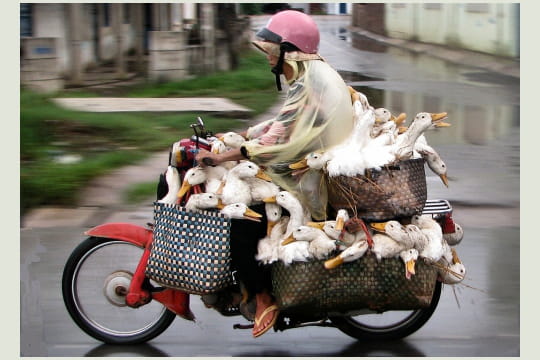
Vietnam's Life On Wheels

One of the magazines I read on line which is truly fabulous is French and is called L'Internaute.
A photo they published this weekend caught my eye, of course, and I couldn't resist. It is so very typical of Viet Nam.

Transport collectif à Hô Chi Minh Ville, Viêtnam. © Jean-Paul Le Cocq
Collective transport in Ho Chi Minh City, Viet Nam.

Saturday, November 22, 2008

Hue and Gastronomy

Prior to our first trip to Viet Nam, I spent about a month and a half doing research in order to have some kind of idea what not to miss where. Of course, Hue is where you can find the glory of past Imperial Viet Nam, to the extent that it is still on UNESCO's list of world heritage sites. But it is also the center of where a lot of the destruction took place during the American War. Additionally, it is known for its amazing cuisine, and has the best University in the entire country. 


Luckily for us we stayed at a hotel that was abutting the Center for Gastronomic Service . It does not look terribly fancy or elegant, but don't let appearances get you down. The food is out of this world. This was the place where we had breakfast the day after we arrived and did most of the sightseeing. It was extremely crowded, and the restaurant is "al fresco" for the most part. While you wait for your food, you will be either charmed or annoyed by vendors, depending on your mood. One other thing that can ruin your meal, if you allow it, is the smell of smoke. Viet Namese are smokers, like most other Asians. And even when you are outdoors, you'll still get several whiffs of it, as the smokers outnumber the non-smokers. 


This is the view from the eating area where we sat, 
which looks quite charming with a lovely fountain in the center, and tropical plants all around.


So if you don't mind sitting on rickety aluminum table and chairs, and spotting a running chicken pecking at the ground, have a seat and enjoy the meal, because you will. This is a good time to explain the coffee filter situation, since I have a photo of it, and as I mentioned in an earlier post, once you have this coffee, it will be difficult to negotiate other ones. It can be served to you hot or cold, and in order to have the hot version, you should ask for 'cà phê sữa nóng', literally hot milk coffee or café filtré. This will be made with sweet condensed milk. For the iced version, ask for cà phê sữa đá, and it is basically the same recipe, with added iced cubes and that you'll stir vigorously with a long teaspoon and enjoy.

If you look closely, you see the glass which has the filter mechanism on top of it also has a thick white lining at the bottom. That is the condensed milk which has not yet been mixed. When enough coffee has made it into your cup, just set aside the filter until you are ready for more. The glass in the forefront shows the coffee has been mixed and some of it already consumed. On the other side is the same operation going on with another glass containing ice cubes. I think you have now been initiated. I remember when they first brought us these utensils to our breakfast table in Sai Gon, we looked at each other like idiots, because we had no clue how these things worked. 

A banana crêpe was beckoning me from the menu and I didn't resist. I had no idea though that what I would later be served and eating was art work. Chuck ordered eggs (at the time of our travel, there was much to do about nothing regarding bird flu, and not eating fowl or eggs). Baguettes are always served at breakfast, and they are crisp and tasty, and have slightly more dough than I am accustomed to. When our food came, my jaw dropped at the sight of the crêpe as I was expecting a pancake stuffed with bananas. I will shamelessly admit that I ate the whole thing. 

With the sunny side eggs came the bread, a few slices of cucumbers and tomato, and the portion was quite generous. This restaurant is a keeper. 


The evening before, after we returned from an exhausting tour of the Forbidden Imperial City, after we crossed the Truong Tien Bridge back to the other side, we got out because we spotted a very large outdoor eatery that served iced cream. It sounded like a wonderful idea, and refreshing, and don't expect vanilla, chocolate and strawberry. These folks learned the art of ice cream from the French, and will have you lick your chops no matter what flavor you choose. Learn that "Kem" is ice cream, and short for "crème" which is the French word for cream. If you want to find it, it is on Le Loi Avenue, right across the street from the Viet Nam Airline ticket office. You have a wonderful view of the Perfume River , and it was almost sunset, which made for a very soothing and romantic mood. 


The Perfume River gets its name from the fragrant flowers that grow alongside its banks.

The menu is in Viet namese, but there do have English translations, and we were happy to get one of those from our waiter. I'm a red bean fan, but I saw "green bean" and was intrigued, and ordered it. Chuck, on the other hand, went American, and selected the banana split with one scoop each of 3 flavors (the ones cited above, of course), which was served with a fluted cookie and walnuts. The first teaspoon of green bean was spectacular, and the ones that followed, no less spectacular. The cookie was light as air. And since my cup was small, I started tasting some of the ice cream in the banana split boat. They use real cream!! Also, remember, you must slow yourself down as much as possible because service takes forever. And this, - with the venue not crowded at all. I think we saw one other family with children in total. 


There was a very large building which looked like a theater of some sort, and after we left "Kem", we started walking around. Again. We went into the building which was completely empty, and there was no one around. Parked alongside the river bank were these adorable duck boats, which I assumed people rented out to glide around on the river. There are also performances which take place on the river, but we unfortunately did not have the time to catch one. 


As the sun was setting, we realized that once back in the hotel, we would not be able to move. So our walk to us to an outdoor restaurant, with tables at seaside. You could see the trees around the tables had been decorated with hundreds of mini-lights that would go on as soon as the sun disappeared. It was very quiet, but as I looked up I saw speakers, and music began to emanate. This might sound bizarre, but the man singing sounded exactly like Engelbert Humperdinck in Viet namese. Since our server did not speak English, there was no way for me to know. But it was lovely and memorable. And we were given menus and started peering at the offerings; here's a sample:
· #61. My (pronounced me) y Sot Bo Bam : Sauteed spaghetti with beef
· #62. My y Sot Hai San : Sauteed spaghetti with seafood
· #63. Vu De Neong : Grilled teats of goat (this one triggered a half hour conversation)
· #64. Tho Hon Banh My : Stewed rabbit with break ( I think they meant bread here)
· #65. Tho Nuong : Grilled rabbit
· # 66. Ca Com Chien Bo : Deep-fried small fish with butter
We settled on a vegetarian dish that was spiced to perfection and quite fragrant. It went down without a hitch. It was a noodle dish with curried vegetables, but you really could not distinguish any heavy curry flavor. It was so subtle, and mixed probably with other aromatic spices. 


And of course, it would not have been as memorable an evening, if it weren't for two young boys who were trying to get some money for polishing our shoes. I was saved, since my shoes were suede boots that could not be touched. So they naturally turned to Chuck, and it became comedic as we realized the tins of shoe polish they had brought with then were empty. Nevertheless the younger of the two boys was earnestly scrubbing away. The other boy had his hand on my camera at one point, and I gave him a look that must have encouraged him to let go of it. All the pictures of the day that I had taken were in that camera, and at that point, I would have killed anyone who would take the camera. 
There is a fabulous dialog going on between the man and the boy in the photo. It turned out that the shoe polish had at some point in its lifetime contained black, and Chuck's shoes were brown. So the man is trying to tell the boy not to shine his shoes because he's got the wrong color. You can see the pained look on the child's face, because he is looking to make some dong this evening. 


At some point, the conversation will have stopped because the grown up realizes that the child is so persistent, he might as well let him have his way. We did manage to find some coins to reward all that hard work. At least they did leave us when the food was served. 


A barge gliding on the Perfume River at Sunset

Romance of HaLong Bay

This video is taken from the "real" vessels that ply the waters of the bay, and not the luxurious Emeraude, which I had the opportunity of boarding twice. It most likely would be a less posh experience, but breathtaking nevertheless. One can never get enough of this spot of paradise.


Related Post: Heaven on Earth

Saturday, November 15, 2008

Hue: How Emperors Lived

The past splendor of this imperial city cannot be justified in the less than 48 hours we allowed ourselves for this visit. The entire schedule was crazy, because there was so much we wanted to see, and so little time we had. Actually, it wasn't a full 2 days, more like a day and a half, with some sleep in between. We arrived by train from Ha Noi, and as usual, expected to be accosted by every cyclo and cab driver waiting for customers at the station. Luckily, our hotel was a stone's throw from the station, but we were carrying way too much. 


As with everything in my travels, I'm not going to take the usual route with you to Hue. That would be to take you to the forbidden purple city, and we'll leave that perhaps for last, since it's "dessert" and should be savored as such. I will take you to an emperor's vacation home, within the confines of Hue, but on the other side of the Perfume River.  Bear in mind that Hue is a UNESCO world heritage site, but it is in desperate need of repair, and some structures have suffered too much damage (during the Viet Nam War) to ever be restored.


On Le Loi Avenue, which is the main drag from the train station, it is rather quiet compared to the frenzy one encounters in either Ha Noi or Sai Gon. You can actually walk if you can stand the heat, by seeking refuge on the shady side. The avenue is tree lined, and as you approach the Truong Tien Bridge to the other side, cyclo drivers will be more than happy to transport you. Once you have crossed the river, (it's a really steep upgrade at first, and those poor drivers really need to hustle), do not get off until the driver has taken you to the gate of the Imperial City. Otherwise, you will end up like we did, - on the outskirts and live bait for other drivers that will literally hound you until you give in to them. 

This particular pair of drivers wanted to show us something out of the ordinary, so far as I was able to understand. It's usually more comfortable for each person to have his/her own cyclo, though we did double up on the way here, and it was murder for the poor driver. So one was driving ahead of the other, and since I had the camera, I was doing all the shooting while Chuck was falling fast asleep in his carriage. And so, we began rolling away from the Citadel to this mysterious destination. 


We passed some very poor areas, with street signs that were lopsided, and ubiquitious laundry lines, and children in their school clothing were either walking or on their bicycles. As we turned another corner, I made the driver stop so I could take a snapshot of what appeared to be the gate to a very elegant residence. There was some construction, apparently unexpected, so we made a detour. As I looked up, I saw rooftops with extremely ornate decorations, very typically Chinese as is the influence here. We will definitely see this influence repeated in the Imperial Citadel, which was modeled after the one in China. 

We finally stopped in front of a breathtaking gate and if a picture is worth a thousand words, then let me save mine, and have you take a look. 


the gate to Heritage House
Needless to say, anything we felt toward our pushy drivers disappeared the very instant we set eyes on this place. I learned that many of these abandoned imperial vacation homes have been turned into "heritage houses", and there are people tending to their upkeep. We were not escorted inside, but we were free to roam and look. I studied the columns of the gate, all the while admiring the ornate dragon relief decorations, all done in ceramic. There are areas that were covered in crabgrass, but they were charming ne
vertheless, as the sound of running streams permeated the air. As I carefully walked on the grass, I spotted a terra cotta container with a mostly spent candle inside. I assumed that at night, they set a romantic mood to this place with strategically placed candle holders like this one.  

I had wanted to see imperial bedrooms in a palatial setting, but this was not to be. Everything to be seen and admired was more or less out in the open, or in recessed covered areas. As you walk to the right from the gate area, you come upon a sitting area; the table and benches are faded, but one can imagine a royal setting. The carved doors are exquisite, and appear newer, or perhaps they had been restored. 

As you can see from the photo, there is a time warp between the wooden doors and the seating area. I did spot one young woman who may have worked there, and she was tending to the seating areas, as if expecting guests.  All the smaller tables in more intimate settings were covered with lace cloths, and I spotted paper menus on table tops. The furnishings in general were made to resemble Chinese cherrywood items. 


A lovely table setting in very serene surroundings


All that is missing are the guests

The architecture of Hue City is a composite of many influences. It was said that one its strongest influences came from Dong Son culture, accompanied by the influx of northern emigrants before the 2nd century and Sa Huynh culture after 13th century. These influences have resulted in the birth of Viet-Champa culture, which during its evolution, did not excluded influences from various civilizations (of southeast Asia, China, India, western countries, etc.). By the way, Champa culture has left some wonderful traces in Nah Trang, which we will be talking about later in the blog. 

Other items to look at and admire were the mother of pearl incrusted wood chests, as well as porcelain vases decorated with indigo blue motifs. The photo shows the high chest, and ceramics, and the pillar in the foreground does not betray the fact that there are only two walls to this "chamber". I got close enough to the statue to scrutinize the mother of pearl adornments which seemed very authentic. The statue must have been of a warrior. 

You might be tempted to purchase vases or ceramics, but you'll be able to make the killing at Bat Trang Village, so save your dong for that trip. However, you'll be glad you came here, which was the "playground" of the Nguyen Dynasty in all its splendor. By the way, Nguyen is the name equivalent of John or James in Viet Nam. Everyone is either a Nguyen, or knows a Nguyen. 


Friday, November 7, 2008

An introduction to Hue


Hue was the ancient Imperial Capital of Viet Nam....this is a wonderful introduction to the colors and sounds...which will be followed by my own experiences.

Wednesday, November 5, 2008

The Meaning of the APEC summit in Vietnam


The Apec Summit took place in Viet Nam for the first time November 18-19, 2006. We had missed it by about three weeks, but signs of it were all over Ha Noi when we arrived. This was the 14th Asia-Pacific Economic Cooperation, which President Bush attended, so in a way, I'm glad we didn't cross paths. Some of the important things which came out of that meeting was the launching of a "Vision Of A Trans-Pacific Free Trade Area", among other ideas to promote and stimulate the economies of the regions. Walking around the capital, you could sense that Ha Noi did go all out to try to impress its visitors.

First, everything around Ha Noi was superclean; there were signs to welcome the various delegates of the Apec Summit, from Noi Bai airport all the way to Ha Noi. And of course, in and around the area of Hoan Kiem Lake, since this is where most everything happens. I happened to meet a woman who was in the capital with a group of French teachers, and I don't recall exactly what it was that made her stop to talk to me. But we ended up exchanging business cards, and I did tell her about the Ha Long Bay experience , as well as the exquisiteness of the Press Club in the French Quarter. 


what a splash of color!

We did learn later on in our journey that HaNoi has a flower market second to none. Though I did not personally make it to the market, as it was going to be an all-male photography event, I have pictures of the vendors, the women and men who tirelessly grow beautiful flowers and make their living at this venue.  Interestingly, while Ha Noi is fast asleep around the wee hour of the morning, some vendors are hauling their goods to the Quang An night flower market  in Tay Ho District.  By sunrise, most of them will have packed up and gone home. 


It was a spectacularly sunny day in Ha Noi, and walking around the lake was invigorating. Aside from these chance encounters which are always so much fun, we were once again reminded of the love of beauty of Ha Noians. Though the Summit was over, some were still lovingly tending to the flower display on one of the lake's banks which spelled out the event in huge letters composed of yellow mums. We would find ourselves again, at another juncture of the trip, knee deep in Viet Nam's flower culture and the quaint way they preserve rose flower buds, with newspaper cones at the tips. In fact, that is just about everywhere they sell roses. 


Directly across the street from the poetry of flowers is a huge statue of Lý Thái Tổ. It's almost as if he is watching over Hoan Kiem Lake from his high post; who was he? He ruled as emperor of Viet Nam for a hair under two decades, from 1009 to 1028. If you are interested in the history of the man, click here. He stands on a very high rectangular pedestal, inside the gated area of a government official building, surrounded by a few steps, and manicured gardens. 
The seat of government is also at this location, and just to make sure I would not make a mistake, I went over to one of the guards outside the fenced property to ask. He was a bit bashful about this English, but nevertheless I encouraged him, and understood that this was official communist party business. Naturally the flag outside is a giveaway.
Thanh Long, Ha Noi's ancient name, will be celebrating its 1000th year founding anniversary in 2010. More specifically, it will be on October 10th of that year, and we are told that this milestone will be a cultural extravaganza like none other...is it too early to mark those calendars? No matter what they do, you can bet your life that a lot of it will be happening around Hoan Kiem Lake.

Friday, October 31, 2008

La Restaurant in HaNoi

I will venture to claim that while in Viet Nam, I cannot think of any meal I had that was not good. Some were exquisite, others were not so exquisite, but on the whole, it's really hard to find anything that isn't tasty.


Another interesting fact is that during both trips to Viet Nam, the majority of restaurants we went to were random. In fact, I recommend that you do the same. Just walk around, and when hunger strikes, stop and you're bound to find yourself not too far from an eatery.

We are now on Ly Quoc Su Street, in Ha Noi's old quarter, and there's construction going on around the sidewalk. It's hot as usual, and restaurants give you an opportunity to cool off and re-energize. We went into "La Restaurant" because it looked pretty from the outside. And it was just as pretty on the inside. It has an amber like atmosphere which came from the color of the walls, on which were hung all sorts of interesting art pieces. From the entrance, one can spot a well stocked bar over which they have hung the ubiquitous "Merry Christmas". It's quiet. A server appears almost immediately, and shows us to one of the empty tables. I love the settings!! Colorful, square plates, covered with crimson linen napkins, and the thoughtful combination of a fork and chopsticks reveals that we can expect a fusion menu. Small, ebony black vases hold fresh roses! 


We are looking at stuffed crepes, and they were ethereal. The photos will give you an idea, but it's impossible to describe the lightness of the crepe. In one of them, it is reminiscent of fluffy beaten egg whites, and the other is somewhat pasty, rice pasty, but extremely light. They stuff them with a combination of meats or fish with subtle spicing (I'm sure ngoc mam figures in there somewhere, as it does in most VN dishes), and though I am chewing very slowly, the crepe is disappearing too fast. 


By Viet Namese standards, the prices are a bit higher than normal. We actually snacked on appetizers for the cost of dinner. An excellent dinner with drinks for two should run about VDN300,000 (divide by 16,000). The menu is not very long, however, it seems that they have emphasized quality over quantity. Did I mention that they serve real butter? 


I have learned since I came back that the man responsible for that amazing atmosphere of "calm and soothing" and excellence in food is called Wayne Sjothun. The absence of screaming TV or very loud music is welcome. You can retreat to La Restaurant and let them pamper you for all it's worth. 
La Restaurant & Bar
Address: 25 Ly Quoc Su Street
Tel: (84-4) 9288933
Hours: 8am - 11pm (kitchen closes)
Prices: VND40,000 - 150,000
General comment: Gourmet dining in a relaxed atmosphere.

Saturday, October 25, 2008

These are a few of my favorite things

These are the ones that I didn't' have to go far to find, but there are others. With two trips to Viet Nam, and time in between in New York to find things I enjoyed there, - most are in the form of food or drink-, others stuff will pop up.

Silk embroidery is one of the specialty handcrafts of the country, and there are two major centers: the first is in Da Lat and the second is in Nah Trang; we were very lucky to find the one in Nah Trang, because we simply were not looking for it. We had been having lunch seaside, and my eye had caught a huge sign that said something about women's crafts. Ironically, no one at the restaurant knew what it was, or perhaps they did not know what I was asking. Curiosity always wins, and so glad it did. The embroidery here is that of a stereotypical Viet Namese with his conical hat, his merchandise and his wheels, without which he probably could not make a living.

I picked that up in Ha Noi actually, not far from Hoan Kiem Lake. You find them everywhere, in little shops, and after a few visits, you begin to know your prices. There are very few which are just black and white, like this one. Most are extremely colorful, and naturally, I have those as well. (See the set of small embroideries top left) They become all the more precious when you have watched the women at work over these huge projects, sometimes, 3 or 4 people are working on one design. I will take you to the art center in another post.

As far back as I can remember, I was always a shawl girl. (woman). That included ponchos, that were hand embroidered, and at one time, my mother-in-law was turning them out faster than I could wear them. I could never understand why every woman in America didn't own at least 10 different shawls. The poncho to the left, for lack of a better word, was purchased in Sa Pa, in the north of Viet Nam. Sa Pa is a mountain resort which was built by the French during the nineteenth century, and if and when you go there, you will think you may have landed somewhere in the Alps. What I loved about this design was the harmony of colors, and the fact that it was reversible.

I had not seen anything like it in Ha Noi. It may not get that cool in Ha Noi, but in Sa Pa, in the evening, this can come in very handy. After all, you are sharing space with Fan Si Pan, the highest peak of the Tonkinese Alps. There are other types of shawls which are just about everywhere. The one I hold very dear was a gift from Van, which I mentioned in another post. She had given it to me when we had lunch at Madame Ann Thuyet Pham. It's a very fine and soft wool, almost cashmere like, and the embroidery is so exquisite, and the color combination of the flowers and petals is nothing short of stunning. Whenever and wherever I have worn it, people have stopped to ask me about it.

Here's another beauty which is a combination cotton/silk and perhaps one other fiber, but I'm not sure. A Ha Noi purchase, and amazingly, when you get back home, you find that it can be worn with a number of pieces of clothing you never remembered you had. Mind you, none of these treasures of mine cost a fortune, but they are treasures nevertheless. Their uniqueness sets them apart from anything else I own.

I am also a costume jewelry fanatic; and for a few years now, silver has been more fashionable than gold, so I was definitely in the right place. For earrings, most of the ones that attracted me were hoops of sorts; interestingly, there were no separate parts, like a post for pierced ears. The earring had a self-closing mechanism which just made life a whole lot easier.

The hoop with the multi-colored metal pieces is the most popular in Sa Pa. Everyone wears them, from the little girls who would be chasing after us (another fabulous story coming), to the older women. But then again, everything they wear is multi-colored, because of the "montagnard" sense of fashion which is somewhat the same as the tribal people we encountered in the North of Thailand. The other silver hoop is less ornate, and I didn't like the way the silver bent itself after using the earring a few times. Lastly, there was a bronze hammered metal hoop that was irresistible. At this time, I will admit that I have lost one of each, but I refuse to let go of the mate.

This necklace would have made Cleopatra jealous. Again, it is worn mainly by the mountain women of Sa Pa, and I bought this during the famous Saturday market, where people from all over the region come and make purchases of just about everything, including foods, fowl, fruit and natural dyes like indigo. There are also things like hooves, and pigs feet for sale. The market is colorful, and a wonderful smell of mountain air mixes with incense and the laughter of children.

The pillow covers you see are again typical of the geometric design and color combination of the north. Ironically, I purchased these in a shop in Ha Noi, before I had ever set eyes in Sa Pa. When I returned, I found more pillow covers, but with different designs and color combinations. Indigo had become prominent. The pillows are set on a love seat in my office, which I purchased when I moved into my new apartment in Bayside in 2004. I never bothered to look at the manufacture, since I assume most everything now is made in China. However, one day, as I got behind the loveseat to find a plug, I looked at the tag, and was shocked! The sofa was made in Viet Nam!

I am a fragrance nut as well. This is deep rooted however, and began with my working for a fragrance manufacturer in my early twenties. They ruined me for life, in that I would change fragrance almost as often as I would my underwear. It had become unthinkable to wear the same fragrance every day.
Some aspects of that habit have not changed, and perfume and colognes are not cheap state side, especially with my taste. Though the bottle of finished, I managed to find Kenzo's Flower perfume which sells for $63 on the internet, for a fraction of the price. I also helped myself to 2 bottles of Burberry for women which you see to the left, and 2 bottles of Hugo Boss. Sai Gon has much more variety than Ha Noi, for some reason, and that is where I will head again the next time. You can also find your favorite perfumed lotions, men's after shaves, make up, - everything you need below duty free prices.

The lacquered sandals you see here are as stunning as they look. They have about a one inch heel and I wore them once, on the Emeraude cruise, at a special dinner. Oddly enough, I had an evening dress to match. These were picked up at the Ben Thanh market in Sai Gon which is an adventure in itself. The day you go there, make sure you have no appointments to keep.

I will try to end this with two important food types which entered my vocabulary since 2005 and never left. One is pho, which is broth with noodles and the other is Ca phe sua (coffee is too simple for this beverage). Of course, one can always go to a Viet Namese restaurant just about anywhere in New York and get both of these items, ready made and served. But, there is something very rewarding when you are home, and decide you are going to make pho, and you get out the biggest pot you can find and go at it. Without the little magic cubes which I found at the Viet Namese market, it wouldn't be pho. Of course, you need rice noodles, of which you will find an astounding variety, lime to taste, but I usually slice a lime and throw it in the broth because I'm a maniac for lime. You can add fish, like prawns, or fish balls which are only available at Asian vendors. Some like beef or chicken, but if you're going that route, why bother? The fish is tastier and healthier. It's the simplest dish of all, and the most rewarding.

By nature, I'm not a coffee drinker. I was weaned on black tea since I was a child, and that's just the way it stayed. From time to time, I will have a latté or a cappuccino, but that's the extent of it. All of that changed in Viet Nam. The coffee there is a remnant of the French influence of café au lait, and they have managed to do something to it by adding sweet condensed milk, and serving hot or cold. The coffee comes with a gizmo that filters it; it's hard to describe, but I have photos for later posts. Making a long story short, it's available here in packets and all you need to do is add hot water.
If you wish to have an iced coffee, then make the hot water anyway, mix your coffee with about 1/3 of a tall glass, and then a fill the rest of the glass with ice cubes. And presto. Starbucks will never make it in Viet Nam, because they just don't need it there.